
The fundamental underlying principle of the IFX Framework is this simple:
Service Providers offer Services to Clients.
This is a business-oriented statement that must be supported with a reliable architecture that can adapt to a wide variety of business partnerships and technical capabilities.
The IFX framework exposes obvious design patterns, standard abbreviations and common message handling techniques that make it easy to work with in any business or technical setting. Â New capabilities can easily be incorporated that are immediately compatible with those previously defined.
Built with the recognition that every business superimposes its own unique practices on any standard, the framework allows for customization and extensibility while adhering to strict design principles needed for large-scale interoperability.
The IFX standard has been built for platform and technology independence and cross-industry applicability based on rich set of common objects, a reliable request-response message protocol and a consistent service-oriented architecture.
The following concepts are key to understanding the IFX framework.
The participating entities in an IFX-enabled solution can be separate financial institutions, corporations, devices, customers or service providers of many varieties â all of which may or may not have pre-established relationships with each other, may or may not reside within the same corporate walls, and may not be located within the same country. Nevertheless, transactions must be reliably directed to and from service end-points with proper authentication, predictable error-handling and auditable results. The IFX standard supports all of this with its service oriented architecture.
Service Providers may be single companies offering many services or multiple companies partnering to provide a single service. The granularity of a service is defined by the institutions offering them, not IFX Forum.  This facilitates service segmentation across business boundaries, technical boundaries or both with complete flexibility within the framework.
Request-Response Message Protocol All data exchanges are handled with a reliable request-response protocol. Predefined messages and message formats simplify initial understanding and later extensions.
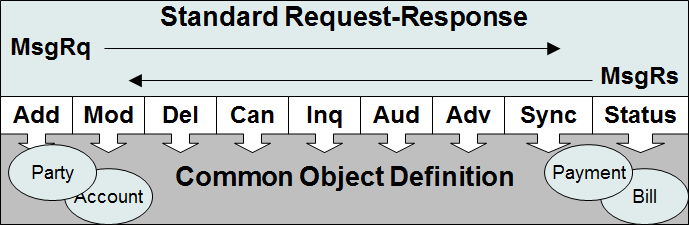
The foundation of the IFX Specification includes a set of common objects that can be used across multiple types of financial services. This facilitates the implementation of cross-service applications.
For example, a common definition for a "customer" (party) is used in EBPP type services, as owners of accounts, parties to funds transfer transactions and a variety of other business applications. A financial institution that wants to offer multiple services (such as banking and insurance) that may be located in different business units can readily take advantage of the common object definition to unify the disparate systems.
Another signficant advantage of the IFX Object Model is that it offers an easy to understand, common reference for mapping your data and your partners' data to the standard.
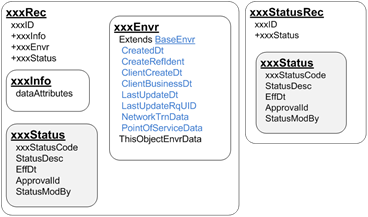
This diagram shows the basic container hierarchy of every object in the IFX Standard. The data attributes commonly associated with and object are found mostly in the xxxInfo segment and the current state of the object is found in the xxxStatus segment.
Here are some key concepts of the IFX Object Model:
The following tables show all of the IFX Objects as of v2.1*. The tables are loosely organized by common service groupings. Note, however, that any IFX object can be used in any context dictated by business need.
| Object Name | IFX Abbr. |
|---|---|
| Account | Acct |
| Account Statement | AcctStmt |
| Account Transaction | AcctTrn |
| Account Transaction Image | AcctTrnImg |
| Object Name | IFX Abbr. |
|---|---|
| Party | Party |
| Party Account Relationship | PartyAcctRel |
| Party Card Relationship | PartyCardRel |
| Party Service Account Relationship | PartySvcAcctRel |
| Party Service Relationship | PartySvcRel |
| Party to Party Relationship | PartyPartyRel |
| Object Name | IFX Abbr. |
|---|---|
| Check Accept | ChkAccept |
| Check Issue | ChkIssue |
| Check Order | ChkOrd |
| Chksum | Chksum |
| Credit | Credit |
| Credit Authorization | CreditAth |
| Debit | Debit |
| Debit Authorization | DebitAth |
| Deposit Application | DepApp |
| Deposit Book Order | DepBkOrd |
| Foreign Exchange Deal Status | ForExDeal |
| Foreign Exchange Quote | ForExQuote |
| Foreign Exchange Rate Sheet | ForExRateSheet |
| Funds Transfer | Xfer |
| Passbook | Passbk |
| Passbook Item | PassbkItem |
| Posting Session | PostingSession |
| Recurring Check Order | RecChkOrd |
| Recurring Transfer | RecXfer |
| Stop Check | StopChk |
| Transaction | Trn |
| Object Name | IFX Abbr. |
|---|---|
| Card | Card |
| Card Account Relationship | CardAcctRel |
| Card Order | CardOrder |
| Card Update | CardUpdate |
| Object Name | IFX Abbr. |
|---|---|
| Comprehensible Remittance Statement | CompRemitStmt |
| Payment | Pmt |
| Payment Authorization | PmtAth |
| Payment Batch | PmtBatch |
| Payment Enclosed | PmtEncl |
| Payment Batch Status | PmtBatchStat |
| Payment Status | PmtStat |
| Recurring Payment Model | RecPmt |
| Remittance | Remit |
| Object Name | IFX Abbr. |
|---|---|
| Bill | Bill |
| Biller | Biller |
| Customer Payee | CustPayee |
| Standard Payee | StdPayee |
| Object Name | IFX Abbr. |
|---|---|
| Device | Dev |
| ICC Update | ICCUpdate |
| Mag Card Update | MagCardUpdate |
| Media Account | MediaAcct |
| Media Account Transaction | MediaAcctTrn |
| Purchase Item | PurchItem |
| Terminal Object | TerminalObj |
| Terminal Service Provider Object | TerminalSPObj |
| Object Name | IFX Abbr. |
|---|---|
| Disclosure | Disc |
| Note | Note |
| Security Object | SecObj |
| Service | Svc |
| Service Provider | SvcProvider |
A standard such as IFX cannot solve every business problem for every organization and remain useful. It must be flexible enough to adapt to different business and regulatory environments while maintaining the integrity of the framework. IFX has published details about how to extend the standard at any level from data elements to message handling and service definition including how clients and servers should respond to extensions that are not supported.
Since all tag names in the IFX Specification follow the same naming conventions, it is relatively easy for a Financial Institution or Service Provider to design customized data extensions. Since all objects are defined with the same structural pattern it is easy to add new objects. And all message names are constructed the same way so it is obvious how to manage new objects whether defined in the standard or as part of a custom extension.